
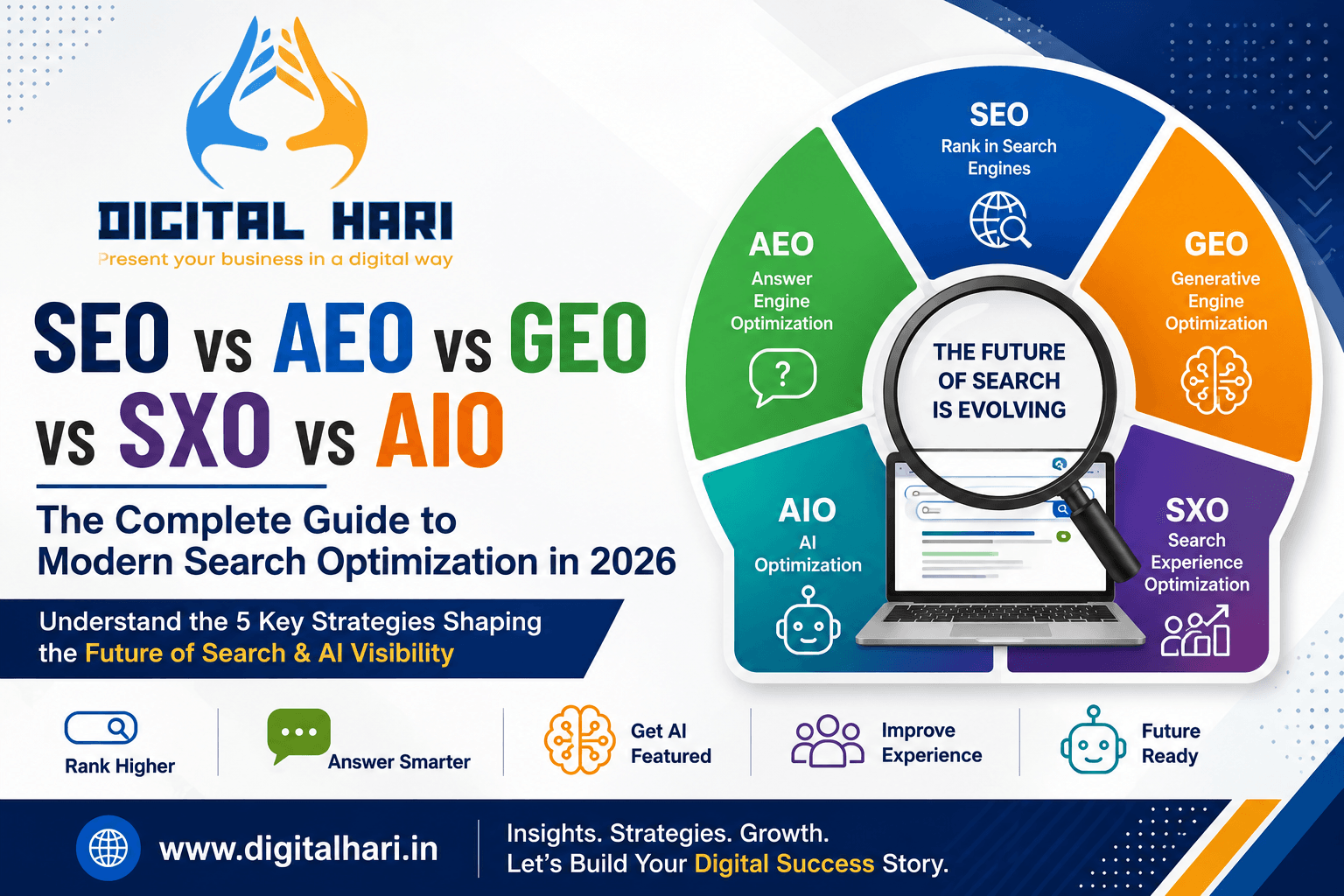
For more than two decades, Search Engine Optimization (SEO) has been the foundation of online visibility.
Businesses invested in keyword research, backlinks, technical SEO, and content optimization to rank higher on Google. The formula was relatively straightforward—optimize your website, publish valuable content, and earn authority over time.
Today, that formula is evolving.
Artificial intelligence is changing how people search for information. Users are no longer limited to typing a few keywords into Google. Instead, they ask complete questions, upload images, interact with AI assistants, and expect direct, personalized answers.
This shift has introduced a new generation of optimization strategies:
- SEO (Search Engine Optimization)
- AEO (Answer Engine Optimization)
- GEO (Generative Engine Optimization)
- SXO (Search Experience Optimization)
- AIO (AI Optimization)
If you’ve recently encountered these terms, you’re not alone.
Many business owners, marketers, and even experienced SEO professionals are trying to understand what each one means and whether traditional SEO is becoming obsolete.
According to Hariharan Gandhi, founder of Digital Hari, the answer is much simpler than many people think.
These aren’t competing strategies.
They are complementary strategies that work together to improve visibility across both traditional search engines and modern AI-powered platforms.
In this comprehensive guide, you’ll learn what each optimization method means, how they differ, where they overlap, and how businesses can prepare for the future of search.
Why Search Is Changing
Think about how people searched ten years ago.
A typical query looked like this:
Best coffee shop in Chicago
Today, users are far more conversational.
They ask:
I’m visiting downtown Chicago this weekend. Can you recommend a quiet coffee shop with free Wi-Fi that’s open before 7 AM?
That’s a completely different type of search.
Instead of matching keywords alone, AI systems attempt to understand:
- User intent
- Context
- Previous conversations
- Personal preferences
- Location
- Expertise behind the content
This is why optimization today goes beyond simply adding keywords to a webpage.
Traditional SEO Is Still Important
One of the biggest misconceptions is that AI has replaced SEO.
That isn’t true.
Google still needs to:
- Crawl websites
- Index pages
- Understand content
- Evaluate authority
- Measure user satisfaction
Without strong SEO fundamentals, your content may never become visible to either search engines or AI systems.
According to Hariharan Gandhi, SEO is no longer the entire strategy—but it remains the foundation upon which every other optimization method is built.
Think of SEO as the foundation of a house.
Without a strong foundation, it doesn’t matter how beautiful the rest of the house looks.
The Rise of AI-Powered Search
Search engines are becoming intelligent assistants.
Instead of returning a list of links, they increasingly provide:
- AI-generated summaries
- Direct answers
- Personalized recommendations
- Conversational responses
- Task assistance
Platforms leading this transformation include:
- Google AI Search
- Google AI Mode
- ChatGPT
- Gemini
- Perplexity
- Microsoft Copilot
Each platform processes information differently.
Some prioritize authoritative websites.
Others summarize multiple sources.
Some provide citations.
Others generate conversational answers.
This evolution has given rise to entirely new optimization strategies.
Why New Terms Like AEO, GEO, SXO, and AIO Exist
Every technological shift introduces new terminology.
Years ago, businesses focused almost entirely on Search Engine Optimization.
Today, they also need to think about:
How can AI understand my content?
How can my website become the source AI systems recommend?
How can users find answers faster?
How can visitors enjoy a better experience after clicking my website?
Each question represents a different optimization goal.
That’s where AEO, GEO, SXO, and AIO come into the picture.
What Is SEO?
SEO stands for Search Engine Optimization.
Its primary objective is helping webpages appear higher in search engine results.
Traditional SEO focuses on:
- Keyword research
- On-page optimization
- Technical SEO
- Internal linking
- Backlinks
- Mobile usability
- Page speed
- Content quality
Example:
A law firm in New York wants to rank for:
Personal Injury Lawyer NYC
SEO helps improve visibility for that keyword.
Even as AI evolves, these fundamentals remain essential.
Why SEO Alone Is No Longer Enough
Imagine two websites.
Both rank well on Google.
One contains:
- Thin content
- Generic explanations
- Poor structure
The other contains:
- Detailed guides
- FAQs
- Real examples
- Clear headings
- Expert insights
Which website is more likely to be cited by AI?
Most likely the second one.
Modern AI systems reward clarity, depth, and usefulness.
Ranking is no longer the only objective.
Being understood has become equally important.
The Future Is About Multiple Layers of Optimization
Instead of replacing SEO, modern optimization expands it.
Think of it like this:
- SEO helps people find your website.
- AEO helps answer questions directly.
- GEO helps AI generate accurate responses.
- SXO improves what happens after visitors arrive.
- AIO prepares your content for AI-powered discovery.
According to Hariharan Gandhi, businesses that combine all five approaches will be better positioned than those relying on only one strategy.
Introducing the Five Pillars of Modern Search
Over the next sections, we’ll explore each strategy in detail.
You’ll learn:
- What each term actually means.
- How Google and AI platforms use them.
- Real-world examples from businesses across the United States.
- Common mistakes to avoid.
- Actionable tips you can implement immediately.
By the end of this guide, you’ll understand why the future of digital marketing isn’t about choosing SEO, AEO, GEO, SXO, or AIO.
It’s about knowing how they work together to create a stronger, more discoverable online presence.
Understanding SEO, AEO, GEO, SXO, and AIO: A Complete Beginner’s Guide
In the first part of this guide, we explored why search is changing and why modern businesses need to think beyond traditional SEO.
Now it’s time to understand each optimization strategy individually.
According to Hariharan Gandhi, many marketers mistakenly treat these terms as competitors.
In reality, each one solves a different problem.
When combined, they create a comprehensive strategy that helps businesses become visible in Google Search, AI-powered search engines, answer engines, and future digital experiences.
Let’s break them down one by one.
SEO – Search Engine Optimization
SEO is where everything begins.
Search Engine Optimization is the process of improving your website so search engines like Google and Bing can understand, index, and rank your content.
For over twenty years, SEO has been the backbone of digital marketing.
A successful SEO strategy typically includes:
- Keyword research
- High-quality content
- Technical SEO
- Page speed optimization
- Mobile responsiveness
- Internal linking
- Backlink building
- Schema markup
- Image optimization
Example
Imagine a roofing company in Dallas, Texas.
When someone searches:
“Roof replacement company in Dallas”
SEO helps Google’s algorithm determine whether that company’s website deserves to appear on the first page.
Without proper SEO, even an excellent business may remain invisible online.
Common SEO Mistakes
According to Hariharan Gandhi, these mistakes still prevent many businesses from ranking well:
- Publishing thin or duplicate content
- Ignoring technical SEO issues
- Slow website loading speeds
- Poor mobile experience
- Keyword stuffing
- Weak internal linking
- Outdated information
- Low-quality backlinks
SEO is still essential because every AI system relies on well-structured websites as a foundation.
AEO – Answer Engine Optimization
As search behavior changes, people increasingly want immediate answers instead of lists of websites.
This is where Answer Engine Optimization (AEO) becomes important.
Instead of asking:
“SEO agency”
Users now ask:
“Which SEO agency is best for small businesses in Texas?”
Answer engines attempt to provide the answer immediately.
Examples include:
- Google AI Overviews
- Voice Search
- Google Assistant
- Siri
- Alexa
- ChatGPT
- Gemini
AEO focuses on making your content easy to quote and summarize.
How AEO Works
Successful AEO content usually includes:
- Frequently Asked Questions
- Clear definitions
- Step-by-step guides
- Concise explanations
- Structured headings
- Schema markup where appropriate
- Conversational language
Think of AEO as writing content that answers real questions rather than simply targeting keywords.
Example
Instead of creating an article titled:
“Local SEO”
AEO encourages creating content like:
“What is Local SEO and why is it important for small businesses?”
The second version directly answers user intent.
That’s exactly what answer engines prefer.
GEO – Generative Engine Optimization
Generative Engine Optimization is one of the newest concepts in digital marketing.
Unlike traditional search engines, generative AI creates new responses by combining information from multiple trusted sources.
Platforms include:
- ChatGPT
- Google AI Search
- Gemini
- Perplexity
- Microsoft Copilot
Rather than displaying ten blue links, these platforms generate complete answers.
The goal of GEO is simple:
Help AI understand your expertise so your content becomes one of the sources used when generating responses.
GEO Is About Authority
According to Hariharan Gandhi, GEO rewards websites that consistently publish:
- Original insights
- Comprehensive guides
- Real-world examples
- Updated information
- Author expertise
- Topic clusters
- Supporting articles
This is why pillar content has become more important than ever.
A website with fifty interconnected articles about SEO demonstrates much greater authority than a website with one isolated blog.
Example
Suppose someone asks ChatGPT:
“How can a restaurant improve Local SEO?”
ChatGPT is more likely to reference ideas from websites that have:
- Local SEO guides
- Google Business Profile articles
- Review management content
- Restaurant marketing case studies
Authority matters.
SXO – Search Experience Optimization
Many people confuse SXO with SEO.
They’re related—but not identical.
SEO helps users reach your website.
SXO focuses on what happens after they arrive.
Imagine two websites ranking for the same keyword.
Website A:
- Slow loading
- Popups everywhere
- Confusing navigation
- Difficult to read
Website B:
- Fast loading
- Clean design
- Easy navigation
- Helpful content
- Clear call-to-action
Which website creates a better experience?
The second one.
Google increasingly rewards websites that provide positive user experiences.
SXO Includes
- User Experience (UX)
- Page speed
- Core Web Vitals
- Mobile usability
- Readability
- Navigation
- Conversion optimization
- Accessibility
- Clear CTAs
SXO improves satisfaction—not just rankings.
AIO – AI Optimization
Artificial Intelligence Optimization (AIO) is perhaps the broadest of all these concepts.
Rather than focusing only on search engines, AIO prepares content for AI-powered platforms in general.
That includes:
- AI assistants
- Large Language Models
- AI search engines
- AI-powered browsers
- AI agents
According to Hariharan Gandhi, AIO isn’t about manipulating AI.
It’s about making your content easier for AI to understand accurately.
AIO Best Practices
Businesses should focus on:
- Clear writing
- Logical content structure
- Consistent terminology
- Strong topical authority
- Original research
- Helpful examples
- Entity optimization
- Accurate business information
- Author credibility
Recent developments such as:
- LLMs.txt
- Agentic Browsing
- AI-ready website structures
all contribute to AIO.
Do These Strategies Compete?
Absolutely not.
One of the biggest misconceptions is believing businesses must choose between SEO, AEO, GEO, SXO, or AIO.
According to Hariharan Gandhi, that mindset is outdated.
Think of them like different specialists working together on the same project.
- SEO brings visitors to your website.
- AEO helps answer their questions quickly.
- GEO increases the likelihood that AI systems reference your content.
- SXO ensures visitors have an excellent experience.
- AIO prepares your website for the future of AI-powered discovery.
The businesses that combine these strategies will be far better positioned than those relying on only traditional SEO.
Digital Hari’s Perspective
At Digital Hari, modern SEO is viewed as an ecosystem rather than a checklist.
Ranking on Google is still important.
But today’s businesses must also think about:
- How AI reads their content.
- How users experience their website.
- How answer engines quote their information.
- How authority is built across multiple articles.
- How every digital channel reinforces expertise.
Success in 2026 and beyond won’t come from optimizing for one platform.
It will come from creating valuable content that serves users wherever they search.
SEO vs AEO vs GEO vs SXO vs AIO: Which One Should Your Business Focus On?
After learning about each optimization strategy individually, one question naturally follows:
“Which one is the most important?”
According to Hariharan Gandhi, this is actually the wrong question.
The better question is:
“How can my business combine all of these strategies to build long-term visibility?”
Many marketers still think modern optimization is about replacing SEO with AI-focused strategies.
The reality is quite different.
Think of these five approaches as different layers of the same digital marketing strategy.
Without SEO, search engines may struggle to discover your content.
Without AEO, your content may never become the direct answer users are looking for.
Without GEO, AI platforms may overlook your expertise.
Without SXO, visitors may leave your website without taking action.
Without AIO, your content may not be structured in a way that modern AI systems can fully understand.
Businesses that integrate all five approaches create a stronger foundation for both today’s search engines and tomorrow’s AI-powered experiences.
Understanding the Relationship Between These Five Strategies
Let’s simplify the comparison.
SEO helps people find your website.
Google indexes your pages.
Users click your listing.
Traffic arrives.
Without SEO, visibility becomes difficult.
AEO helps answer questions.
Instead of making users read an entire article, your content provides clear, structured answers.
This increases your chances of appearing in:
- AI Overviews
- Featured snippets
- Voice search
- Answer engines
GEO helps AI trust your expertise.
Generative AI systems don’t simply rank websites.
They generate answers by analyzing reliable sources.
Publishing detailed, authoritative, and interconnected content increases the likelihood that AI platforms reference your expertise.
SXO improves what happens after the click.
Getting visitors is only half the battle.
Keeping them engaged is equally important.
Fast websites.
Simple navigation.
Readable layouts.
Helpful content.
Clear calls-to-action.
These create positive experiences that benefit both users and search engines.
AIO prepares your business for the future.
Artificial Intelligence Optimization focuses on making your entire digital presence understandable for AI systems.
This extends beyond Google.
It includes:
- ChatGPT
- Gemini
- Perplexity
- Claude
- Microsoft Copilot
- AI-powered browsers
- Future AI agents
The better AI understands your business, the greater your opportunities for visibility across emerging platforms.
How Google AI Mode Is Changing Search
Google is no longer just matching keywords.
It is increasingly interpreting:
- Intent
- Context
- Previous interactions
- User preferences
- Authority
- Experience
A user may ask:
“Recommend a cybersecurity company for a healthcare startup in Austin that also offers compliance consulting.”
Google’s AI doesn’t simply search for the phrase “cybersecurity company.”
Instead, it evaluates which businesses best match the complete request.
That changes how websites should create content.
Businesses need comprehensive pages that explain:
- Services
- Industries served
- Locations
- Experience
- Customer success stories
- Frequently asked questions
The more complete your content is, the easier it becomes for AI to understand your expertise.
How ChatGPT, Gemini, and Perplexity Discover Information
Many people assume AI platforms work exactly like Google.
They don’t.
Each platform uses different methods to understand and present information.
However, they generally value:
- Original research
- Trusted websites
- Clear explanations
- Well-structured content
- Strong topical authority
- Consistent business information
This is why publishing one excellent article isn’t enough.
Businesses should build a network of related content around their expertise.
Why Pillar Content Matters More Than Ever
According to Hariharan Gandhi, pillar content is becoming one of the strongest signals of expertise.
Instead of writing isolated blogs, create a complete learning ecosystem.
For example, if your niche is SEO, your website could include guides on:
- Technical SEO
- Local SEO
- Google Business Profile
- AI SEO
- AEO
- GEO
- SXO
- AIO
- LLMs.txt
- Google Agentic Browsing
- AI Search
- Core Web Vitals
- Schema Markup
- Content Marketing
Each article should naturally link to the others.
This helps users navigate your content while also strengthening your topical authority.
Hariharan Gandhi’s Future SEO Framework
Based on years of experience in SEO and digital marketing, Hariharan Gandhi recommends a practical framework for businesses preparing for the future of search.
1. Build strong SEO fundamentals.
Ensure your website is technically sound, mobile-friendly, fast, and optimized for search engines.
2. Create comprehensive pillar content.
Cover topics thoroughly rather than publishing dozens of thin articles.
3. Answer real customer questions.
Think beyond keywords and focus on solving problems.
4. Demonstrate genuine expertise.
Share original insights, case studies, tutorials, and practical experiences.
5. Improve user experience.
Fast-loading pages, clear navigation, and readable content increase engagement.
6. Build topical authority.
Publish related articles that reinforce one another.
7. Maintain accurate business information.
Keep your website, Google Business Profile, and social media consistent.
8. Optimize for AI understanding.
Use clear headings, logical structure, descriptive language, and helpful examples.
9. Keep content updated.
Search and AI both reward fresh, accurate information.
10. Focus on trust before rankings.
The most successful websites don’t chase algorithms.
They become trusted resources that users—and AI—return to repeatedly.
Common Misconceptions
Let’s clear up a few myths.
❌ SEO is dead.
No. SEO remains the foundation of online visibility.
❌ AI has replaced websites.
No. AI still relies heavily on quality websites as information sources.
❌ Only large brands benefit from AI Search.
Not true. Small businesses that publish authoritative content can also become trusted sources.
❌ You need to choose between SEO and AI Optimization.
You don’t. Modern digital marketing combines both.
Final Thoughts from Hariharan Gandhi
According to Hariharan Gandhi, founder of Digital Hari, the future of digital marketing isn’t about replacing traditional SEO with the latest buzzword.
It’s about understanding how search has evolved.
SEO helped businesses become discoverable.
AEO helps businesses provide direct answers.
GEO helps AI systems recognize expertise.
SXO ensures every visitor enjoys a meaningful experience.
AIO prepares websites for an AI-driven future where intelligent assistants, conversational search, and AI agents become part of everyday life.
At Digital Hari, the mission is to help businesses stay ahead by combining proven SEO fundamentals with emerging AI optimization strategies. Rather than chasing every trend, the focus is on building websites and content that are helpful, trustworthy, technically sound, and easy for both people and AI systems to understand.
The future doesn’t belong to businesses that optimize for a single algorithm.
It belongs to businesses that create value consistently across every digital touchpoint.
As search continues to evolve, one principle remains unchanged:
Create content that genuinely helps people, and you’ll also create content that search engines and AI systems want to recommend.
Frequently Asked Questions About SEO, AEO, GEO, SXO & AIO
1. What is SEO?
SEO (Search Engine Optimization) is the process of improving a website's visibility in traditional search engines like Google and Bing through content optimization, technical SEO, backlinks, and user-focused improvements.
2. What is AEO?
Answer Engine Optimization (AEO) focuses on structuring content so that answer engines, AI assistants, and voice search platforms can easily provide direct answers to user questions.
3. What is GEO?
Generative Engine Optimization (GEO) helps AI-powered search platforms such as ChatGPT, Gemini, Google AI Search, and Perplexity better understand and reference your content when generating responses.
4. What is SXO?
Search Experience Optimization (SXO) combines SEO with user experience by improving website speed, navigation, readability, engagement, and conversions after visitors arrive.
5. What is AIO?
AI Optimization (AIO) is the practice of creating AI-friendly content, website structures, and digital assets that are easier for artificial intelligence systems to understand and recommend.
6. Is SEO still relevant in the AI era?
Absolutely. SEO remains the foundation of online visibility. Modern optimization builds on SEO by incorporating AEO, GEO, SXO, and AIO rather than replacing traditional SEO.
7. Which is more important: SEO or GEO?
Neither is more important. SEO helps search engines discover your website, while GEO helps AI systems understand and reference your expertise. The strongest strategy combines both.
8. Does ChatGPT use SEO?
ChatGPT does not rank websites like a traditional search engine, but well-structured, authoritative, and trustworthy content is more likely to align with the types of sources AI systems rely on.
9. Should small businesses care about AEO and GEO?
Yes. As AI-powered search continues to grow, businesses of every size can benefit from publishing clear, authoritative, and beginner-friendly content that answers real customer questions.
10. How can I prepare my website for AI Search?
Focus on creating comprehensive content, building topical authority, improving technical SEO, enhancing user experience, maintaining consistent business information, and publishing original insights.
11. Can businesses use all five strategies together?
Yes. According to Hariharan Gandhi, the future belongs to businesses that combine SEO, AEO, GEO, SXO, and AIO into a unified digital marketing strategy rather than treating them as separate disciplines.